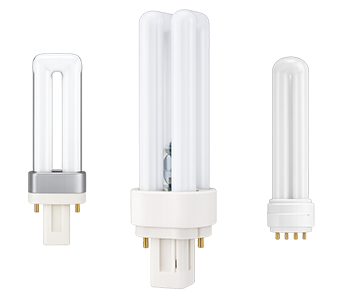
We’ve provided several answers to questions related to CFL Plug In (2-4 pin) , see some other helpful Q&A related to this product.
-
Question: What fixtures use plug‑in CFL lamps?
Answer: Plug‑in CFL lamps are commonly used in recessed downlights, wall sconces, ceiling fixtures, and commercial lighting systems designed for compact fluorescent technology.
-
Question: Are CFL plug‑in lamps energy efficient?
Answer: CFL lamps are more energy efficient than incandescent lamps and produce more light per watt. However, many facilities are transitioning to LED replacements for even greater efficiency and longer lifespan.
-
Question: Can CFL plug‑in lamps be replaced with LED lamps?
Answer: Yes. Many CFL plug‑in lamps can be replaced with LED plug‑in retrofit lamps that use the same base type. Some LED replacements operate with existing ballasts while others require bypassing the ballast for direct line voltage operation.
-
Question: What color temperatures are available for CFL plug‑in bulbs?
Answer: CFL plug‑in lamps are available in several color temperatures including 2700K warm white, 3000K warm white, 3500K neutral white, 4100K cool white, and 5000K daylight.
-
Question: How long do CFL plug‑in lamps last?
Answer: Most CFL plug‑in lamps have an average rated life between 10,000 and 20,000 hours depending on operating conditions and ballast quality. Frequent switching or poor ventilation can reduce lamp life.
-
Question: What base types are used on CFL plug‑in lamps?
Answer: Common CFL plug‑in bases include G23, GX23, G24d, G24q, GX24d, and GX24q configurations. The specific base type determines whether the lamp is a 2‑pin or 4‑pin design and which fixture it is compatible with.
-
Question: What wattages are available for CFL plug‑in lamps?
Answer: CFL plug‑in lamps are available in several wattages including common options such as 9W, 13W, 18W, 26W, 32W, and 42W. The wattage determines the light output and is selected based on the fixture and application requirements.
-
Question: Where are plug‑in CFL lamps commonly installed?
Answer: Plug‑in CFL lamps are frequently installed in commercial lighting fixtures such as office downlights, wall sconces, corridor lighting, hotel lighting fixtures, and task lighting applications.
-
Question: What is the difference between 2‑pin and 4‑pin CFL lamps?
Answer: 2‑pin CFL lamps contain an integrated starter and are designed to operate with magnetic ballasts. 4‑pin CFL lamps do not include a starter and require an electronic ballast, which allows better efficiency and supports dimming in some lighting systems.